calm breeze

Sunday, November 24, 2013

Digital Information Diet: Detox in the Works

This week, I took a long, hard look at another aspect of my health: my informational diet.  It wasn't very intellectual from a professional stand point.  Yikes.  Facebook, Pinterest, and a RSS feed populated with cooking and 'foodie' blogs were my main source of information.  I use my Twitter account for professional purposes, but most of my informational diet consisted of digital 'junk food.'  It was time to consider a digital detox.

Photo by Graham Steel Creative Commons Attribution-ShareAlike 2.0 Generic
Why wasn't I as cautious about my informational diet?  That's not to say that what I was reading and filtering through was worthless.  Quite the contrary!  I have found and created many useful things and skills from these.  But in intellectual/informational diet consisting of fairly shallow topics and insights is not healthy.  From a professional growth stand point, I wasn't taking in much information that I could use to grow to become a better educator.  And I have changed that with the addition of a three new blogs to my RSS feed. 

All of these new blogs tie in with education; specifically the Common Core State Standards (CCSS) and the varying and often controversial views surrounding them.  The CCSS alignment has been a fact of my career since I began four years ago.  I was aware of very little outside of my own school district and I am seeking to change that now.

The first addition to my RSS feed was Homeroom, the official blog of the US Department of Education, @usedgov.  I chose this resource because while most of the impact in education that I feel directly comes from the State of Michigan, the US Department of Education and the actions of the federal government do effect my job as a teacher.  The ties between The Race for the Top and the CCSS have caused quite a controversy between educators, parents, and politicians.  I feel is is only wise as a teacher and a citizen to keep my finger on the pulse of what my government's current educational views are. 

Another new addition to my feed is Teaching the Core: A Non-Freaked Out Approach to Teaching the Common Core by Dave Stuart, Jr., @davestuartjrhttps://twitter.com/davestuartjr First off, the title of his blog not only made me laugh, but it also caught my attention.  Until recently, I didn't realize that there were so many educators who did not support the adoption of the CCSS.  Either I live in a cave (my classroom) or I have my eye so focused on learning and aligning my own curriculum to the CCSS, I wasn't paying attention.  Stuart's blog is a resource for teachers who have questions about the CCSS and its implementation.  His tips, tricks, and tidbits are authentic and engaging.

The last addition completely opposes my view of the CCSS: Us Against Common Core. This blog for parents and educators against the CCSS is a platform for their voices.   I feel it is important to consider the opinion and value the insight afforded by looking at the opposition and this is no exception.  I have some parents asking me questions about the CCSS and my thoughts on teaching them.  Having the knowledge of the opposing view helps me to understand these concerns in a more well-rounded fashion.

I am confident these new additions to my informational diet will expand my view points on the CCSS as well as becoming a more knowledgeable educator with a more worldly view of this controversial topic and others to come. 

Monday, November 18, 2013

Texting for Social Engagement with Autism Spectrum Disorder

My graduate assignment this week had me 'choosing my own adventure' while I explored and researched a special need, disability, or learning challenge I was interested in learning more about.  I fumbled a bit at the beginning as I tried to make this assignment meaningful to myself as a educator.  I have several students with various 'undiagnosed' learning disabilities and needs, but nothing specific enough for my assignment.  Then I thought about some of the children I have encountered in my elementary over the past few years.  Even though they were not students of 'mine,' I still had daily interactions with these individuals and I wanted to understand them better and how I can communicate more effectively with them as a member of their learning community.  Both of these students have Autism Spectrum Disorder (ASD).

Autism is a group of developmental brain disorders, collectively referred to as autism spectrum disorder.  Due to the widely ranging symptoms, skills, and degrees of impairment, ASD is considered to be spectral:  some individuals with ASD are only mildly impaired by their symptoms, while others are severely disabled. With special education now being integrated into general education classrooms, it is becoming more important to teach social and communicative skills to ASD students to help support them with peer interactions.

Read more in-depth about Texting for Social Engagement with Autism Spectrum Disorder here.

I believe text messaging would be a wonderful way to teach high-functioning ASD children how to have an authentic conversation with a peer in a meaningful way.  Texting is already an integrated part of our lives today.  It makes some other social impairment symptoms (lacking eye contact, facial expressions, etc) non-issues for the ASD child, scaffolding his or her communications as they learn conversational practices.  Text messaging also allows for picture communication on most phones through emoji or photographs, which supports the Augmentative and Alternative Communication (AAC) method that is currently very successful with ASD students.


Here is an example of a mother communicating with her autistic teenage son through text messaging. 


Vera Word reads a text message typed by her son Jonathon on his cell phone screen. The cell phone is a new tool for the two that has enabled Jonathon, who has autism, to communicate with his mother and his teachers through text messaging.

Jonathon Word’s fingers fly over his phone’s keyboard as he communicates via text-message. Because he can’t talk, this has proved to be the best, most portable way for his mother and teachers to penetrate his autistic world. The 15-year-old student is in the autism program at Harrell Accelerated Learning Center,


Work, A. (2009) Teen With Autism, Mom Communicate Via Texting. Times Record News.  Retrieved from http://www.timesrecordnews.com/news/2009/dec/11/modern-miracle-n-teen-with-autism-mom-via-ann/

Sunday, November 3, 2013

Breaking Free of Formal Education as We Know It

For my CEP 812 graduate class, we took at look at James Paul Gee's recently published book The Anti-Education Era: Creating Smarter Students through Digital LearningAs a digital literacy educator, Gee takes a look deeper look at the effects of current mindsets involving digital and social media as well as how we are failing to use these technology tools to make us smarter problem solvers.  

A student engaged in an authentic writing assignment.
This assignment required the close and reflective reading of Part I: How to Be Stupid.  With a title like that, who wouldn't want to know how to break that bad habit?  Throughout the following chapters, Gee laid the ground work for the limitations humans are allowing themselves to become trapped by as well as offering thoughts of what can be done to break free of these limits.  

Here is a pick into my reflection on Gee's book thus far.  This Google Doc is a summary of Gee's theories as well as my ponderings on "What limitations prevent us from solving big, complex problems smartly?"  

Sunday, October 27, 2013

A Quick Look at Problems of Practice

This week is the first week of my third (and final) course in the Educational Technology Certificate Program through Michigan State University: CEP 812: Applying Educational Technology to Problems of Practice In this class, I will be investigating ways a variety of technologies can be applied to problems relating to education and teaching. 

The focus of this week was learning exactly what 'problems of practice' are.  After learning about well-structured, complex, and wicked problems, I explored and browsed some digital technologies that have some promise in helping to solve well-structured and complex problems within my classroom.

Here is a screencast I created to share one of these technology tools, GoAnimate, and how I would integrate it into my teaching to support teaching and learning a complex problem within my classroom:


Unable to display content. Adobe Flash is required.
GoAnimate is free in its most basic form, but schools can purchase a subscription to GoAnimate for Schools.  I found the free version to be completely adequate for the needs of my fourth graders.  I cannot wait for my students to being experimenting with retells and sharing them with their classmates!

Tuesday, October 22, 2013

Seven Weeks In and Counting...

Hello all!  I am still alive and kicking in my fourth grade classroom for the 2013-2014 school year.  That being said, it was a rough start to the year:  new principal = new expectations and procedures to learn; new staff (one of the few nearby school districts to HIRE); new assessments and benchmarks.

But I managed to sneak in an amazing field trip opportunity for my class...a day trip to ArtPrize 2013.  I have wanted to contrive a way to take a group of students to ArtPrize for years...even conspiring with our art teacher to find ways to tie in our curriculum and justify the trip.

This year was THE YEAR.  I approached our new principal with my crazy scheme, being sure to link the experience back to reading, writing, and math.  He gave me the go-ahead as long as I was able to raise enough money to cover the entire cost of the field trip.  (Recent budget cuts really put a hamper on extra little things like field trips...)  This trip was also an exploratory expedition of sorts for other classrooms during ArtPrize 2014.  The expectations were set high to pull this crazy scheme off.

Through the ArtPrize Education Days, I was able to apply and receive a $100 busing grant to help cover the cost of transportation.   And since my game plan was to do a walking tour of the art throughout downtown Grand Rapids, there were virtually no other expenses...just the bus.  To raise the rest of the money for the field trip, I went to parents and guardians of my students...and boy, did they respond.  Within one week, we had fully funded our field trip!

Fingers crossed, we planned the field trip, integrating ties to the core curriculum (math=scale, proportions, shapes; reading/writing=story starting, summarizing, small moment writing, sketch books for responses and art analysis) and preparing the students for the experience.  Praying for the unpredictable Michigan weather to hold out for us.  And it was a perfect day!  Couldn't have asked for a better field trip for my students and their parents.  The pictures say it all...
"In the Dog House" by Ritch Branstrom

Many of the exhibits were 'hands on' and interactive pieces.
"Earth Giant" by Benjamin Gazsi


"Good Luck Fish" by Lou Rodriques

"Bigfoot: Watch for the Sqatch" by Justin La Doux


"Silkwaves in the Grand" by Al & Laurie Roberts

"Back to Eden" by Dave MacKenzie of LiveWall/Hortech

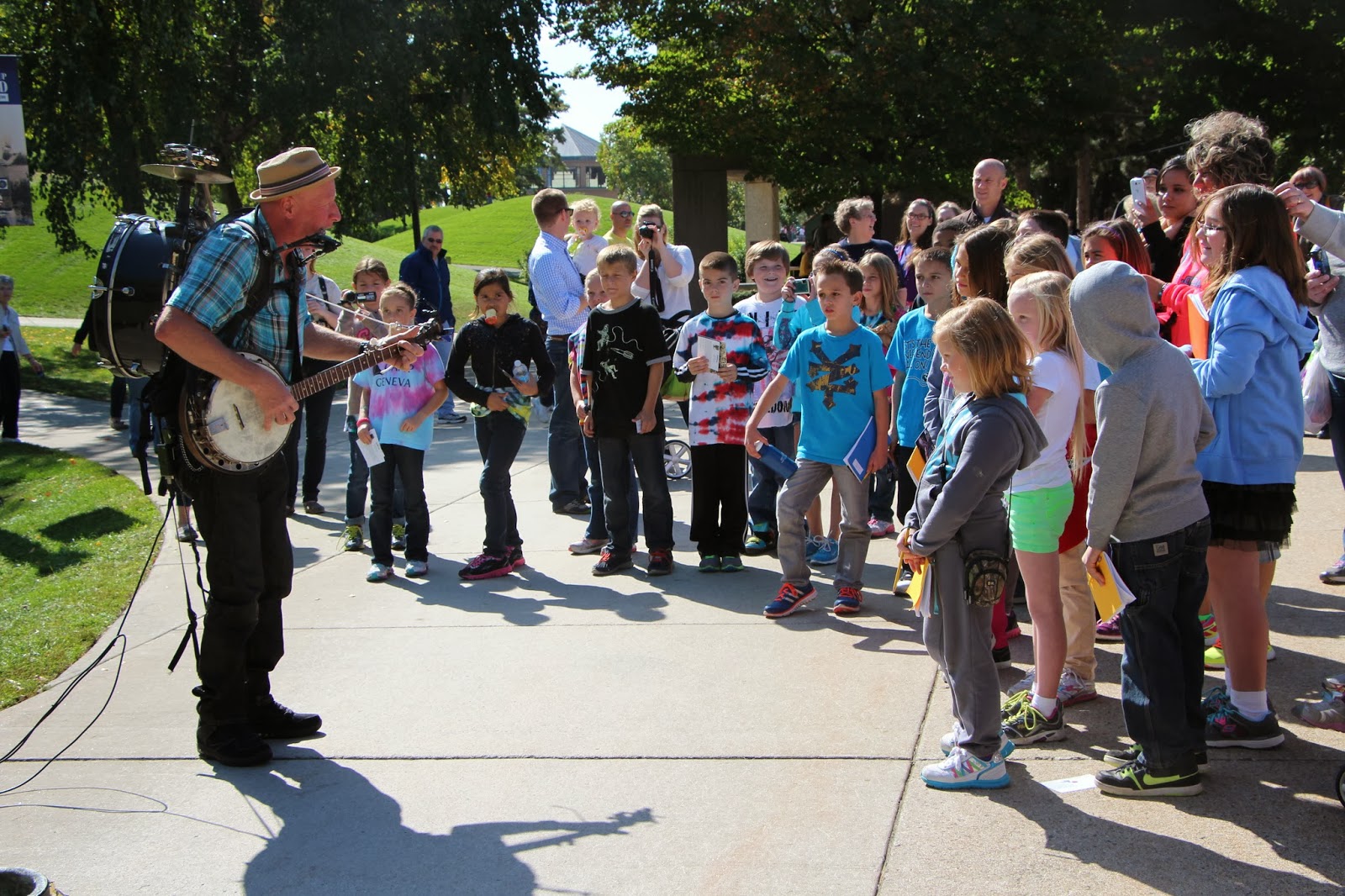
A One-Man Band in front of Gerald R Ford Presidential Museum

"Moving Violation" by Robert Shangle...performance art.


At the end of our amazing experience, the students were so inspired, they created their own collaborative piece of art.  I am beyond proud of their creativity and how well they cooperated on this...and this was after only being a learning community for three weeks!  We submitted their work to the ArtStart competition.  While their piece did not win the contest, truly at the end of the day, the field trip was so memorable for my students...and that was the true intent of this authentic learning experience.

Sculpting Impressions


Artists' Statement: When you look at our artwork, we hope you notice our shapes that represent the silhouettes of our four favorites sculptures from ArtPrize: Earth Giant; In the Dog House; Uplifting; and Monty.  Our words describe the thoughts and feelings we had on our creative, one-of-a-kind adventure and our impressions when we looked at the art.  We studied the elements of art, such as form, shape, color, media, and techniques.  This piece describes our ArtPrize experience.


Thursday, June 27, 2013

Maker Experiment #3 - Reflection

As I wrap up my final week of CEP 811: Adapting Innovative Technologies to Education, I've reflected on the work and tasks I've been assigned: exploring the 'maker culture'; repurposing & creativity; learning theories; instructional design; experience design; universal design for learning; scholarship of teaching and learning; design evaluation.  While I did engage and experiences some of the newer technologies, I found this course was more about making use of existing technologies and materials as well taking into consideration past and current 'best practices' to create a true 21st Century learning environment.

Professional Assessment & Evaluation
My favorite part of my experience has been playing with my chosen Maker Kit, the littleBits Starter Kit, and seeing how the science of electricity and creative technology melded together.  It was so much fun to sit down with this product and experience it for the first time and even better to see the delight of my five year old's face when he created his first circuit.  I cannot wait to bring my littleBits into my classroom next year.  I have already shared these little treasures with my grade level team.  We have hacked out a plan to share my kit and some of the extensions I have purchased amongst the six of us for our electricity unit.  The scientific inquiry experiences that this Maker Kit will bring to my classroom and my students will be priceless.

To evaluate the effectiveness of the littleBits will be largely based on student self-assessment and their synthesis of the littleBit components work, connect, and operate as units.  The biggest part of the effectiveness evaluation will be formative assessment, which will allow me to adjust how the Maker Kit is being used and implemented within my curriculum.  In the grade scheme of my electricity unit and the standards I am responsible to teach, circuitry is only a small chunk of it.  However, I can, and will, align these experience learning projects with the CCSS in the area of ELA, since I plan on incorporating student blog posts as one form of self-assessment and reflection. 

Personal Assessment & Evaluation

"As adult learners, we are most interested in your growth -- and you will be evaluated on the basis of how far you go, not on the basis of where you started." -MAET statement on evaluation

I feel that I have grown significantly as both a professional educator and as a student through this course.  Many of my personal educational philosophies were justified and expanded upon through the research and assignments I completed these last eight weeks.  As a 'younger' teacher, technology has been a major part of my life from a very early age and I have always been one of the 'techies' on my school staff.  My comfort level and desire to learn more about educational technology was the main reason I chose to pursue a degree in the MAET program through MSU.  So while my technology foundation may not have grown through this course, I definitely feel as though I have built several structurally-sound columns that enable me to be a more effective 21st Century educator. 

Two areas that I enjoyed exploring and learning about the most were Instructional Design and Experience Design.  Both of these topics fit right in with the Responsive Classroom model that I adopted in my classroom a few years ago to create and foster a positive learning environment for my students.  The research and knowledge gained from these two topics have changed the way I view my classroom and pushed me to change the format and function of my classroom space.  I plan on redesigning my classroom to be a more flexible and dynamic space to allow for more movement and flow during the learning process. 

Although my graduate experiences with educational technology have just begun, I am very excited with where I will go professionally and personally.  I hope to continue to be a educational technology leader within my PLN and school district.  The confidence I now have with digger deeper into technology integration will enable me to be a more effective and engaging teacher for my students.

Monday, June 24, 2013

Choose Your Own "SoTL" Adventure

I laughed a bit when I saw the title of this week's blog post assignment for my CEP 811 graduate class through Michigan State University.  "Choose Your Own 'SoTL' Adventure."  Remember back in grade school, there were these choose-your-own-adventure books?  You could choose to turn right or turn left, help an enemy or move on.  Kinda like a book version of Oregon Trail.  I found this funny because I had discovered a series of historical fiction books that did just that...and my students loved them!  Here is a link to one that I read aloud during our history unit: http://www.amazon.com/The-Civil-War-Interactive-Adventure/dp/1429639105  They are worth checking out!

Back to reality and graduate class assignments.  This week, since I am a Master's student and therefore am already partaking in 'Scholarship of Teaching and Learning,' I was asked to 'consume' information about a research topic I am interested in and push my scholarly ways a bit further and share my findings with my PLN (professional learning network).  A classmate and I developed a conference proposal about designing and creating a 21st Century classroom, so it made sense to direct my efforts in this direction.  Here are brief annotations of the scholarly articles I read on my research topic.


Annotated Biography

Christen, Amy. "Transforming the Classroom for Collaborative Learning in the 21st Century." Techniques: Connecting Education and Careers 84.1 (2009): 28-31. ProQuest. Web. 24 June 2013. Retrieved from http://www.eric.ed.gov.proxy1.cl.msu.edu/PDFS/EJ829507.pdf

I truly enjoyed the many points made in this article.  It states how technology hasn't fully penetrated into modern classrooms and learning environments, mainly due to the fact that schools are not taking advantage of public and private sector partnerships that could make technology more meaningful and accessible to students and teachers.  The article goes a step further, offering suggestions for schools and educators to begin to correct this situation.

Kwek, S.H. (2011). Innovation in the Classroom: Design Thinking for 21st Century Learning. (Master's thesis). Retrieved from http://www.stanford.edu/group/redlab/cgi-bin/publications_resources.php

In this Master's thesis, Kwek summarizes a qualitative study of a San Francisco Bay Area school explored and adopted design thinking as a model of learning.  The data collected from observations and interviews of school administrators and educators supports the need for changes in classroom learning environments and curriculum/lesson design.


Theisens, Henno, Francisco Benavides, and Hanna Dumont. "OECD Work on Future Educational Environments." PEB Exchange (2008): 11. ProQuest. Web. 24 June 2013.  Retrieved from http://search.proquest.com.proxy1.cl.msu.edu/docview/189838044/fulltextPDF/13EDC10DAE118E44AED/117?accountid=12598

 This was a very enlightening article.  It focuses on the challenges schools face when designing and planning for future learning environments.  Social demographics, such as falling birth rates, economic globalization, and rising numbers of single-parent families, play heavily into this concept.  The authors also go beyond talking about the physical structures of the building and how these buildings need to facilitate, motivate, and enable creative learning within students.


Wambach, Catherine. "From Revolutionary to Evolutionary: 10 Years of 1-to-1 Computing." T.H.E.Journal 33.14 (2006): 58-9. ProQuest. Web. 24 June 2013.  Retrieved from http://search.proquest.com.proxy1.cl.msu.edu/docview/214818737/13EDC10DAE118E44AED/93?accountid=12598

 I found this article to be interesting, especially since my school district's county is petitioning for a 1-to-1 Technology Initiative to be put on the ballot in September.  It outlines the slow but successful progression of schools that have implemented 1-to-1 computing and how it has created a more equalized learning environment/opportunities for students.  In the progression over the course of the past ten years, these schools have gone from classroom computers, to mini-labs, to wireless laptop carts, to tablets. 


Williams, Kevan. "WHAT'S UP IN NEW DEVELOPMENT." Flagpole Apr 25 2012: 7. ProQuest. Web. 24 June 2013 .  Retrieved from http://search.proquest.com.proxy1.cl.msu.edu/docview/1019782459/13EDC10DAE118E44AED/58?accountid=12598

This article examines the changes one school district is making while planning and building new schools while taking into account the needs for a 21st Century classroom and 21st Century learners.  The district's administrators and planners have designed learning environments that allow for dynamic collaboration, flexible spaces, and furnishings that meet the needs of both educators and learners.